Thailand’s Land Bridge project could bypass the PRC’s Malacca dilemma. What are the Policy Implications for the United States?
By: Aom Boonphatthanasoonthorn
Key Takeaways
- US strategic interests in the Indo-Pacific could be challenged if the Thai government’s proposed Land Bridge across the Malacca Strait proceeds without US involvement.
- An alternative to this major maritime bottleneck could cut shipping time by up to 4 days, benefiting all sorts of global trade but particularly China and other East Asian countries importing oil from the Middle East.
- Interested financing partners for the Land Bridge include China, whose energy security would be greatly strengthened since roughly 80% of its oil imports pass through the Malacca Strait.
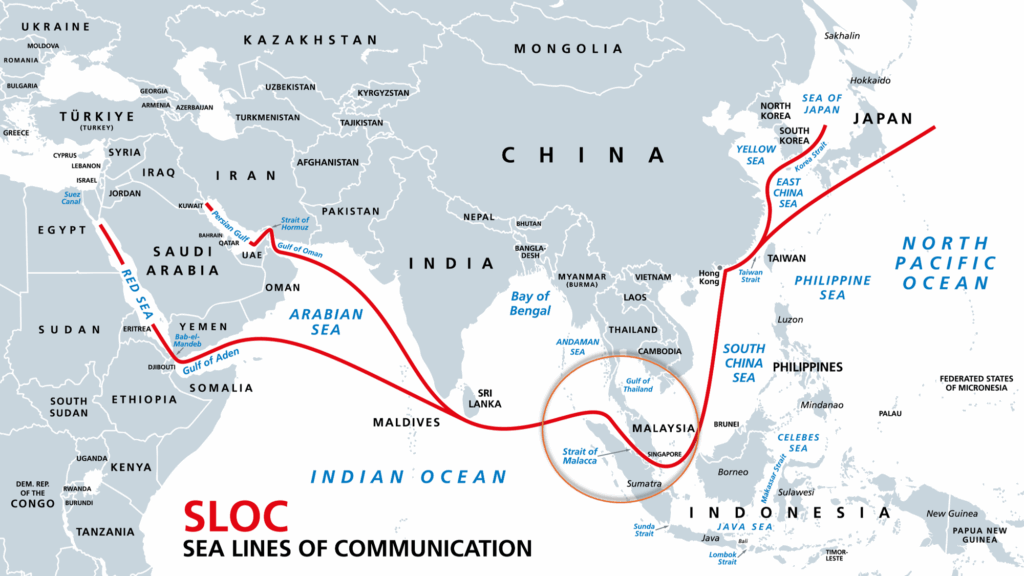
In 2023, the Thai government introduced the Land Bridge project, an infrastructure initiative aimed at connecting the Gulf of Thailand and the Andaman Sea through a 90-kilometer land bridge across the Kra Isthmus in southern Thailand. The Land Bridge project includes the development of two deep-sea ports, one on each coast, allowing cargo containers to be offloaded, transported over land, and then reloaded onto another vessel to the destination. According to a feasibility study conducted by the Thai government, the Land Bridge project could cut shipping time by up to four days compared to the regular route via the Malacca Strait. With over 90,000 ships transiting annually, the Malacca Strait remains a vital maritime chokepoint for the region, particularly for East Asian countries importing oil from the Middle East. Traffic through the Malacca Strait is projected to grow by 2% annually through 2030, potentially worsening congestion, shipping delays, and freight costs. The Thai government envisions the Land Bridge project as a strategic response to growing congestion in the Malacca Strait. Estimated to cost approximately 1 trillion Thai Baht, or USD $29 billion, the project is planned under the public-private partnership model. By capitalizing on its geographic position, Thailand seeks to boost economic competitiveness and strengthen its geopolitical influence in the region. Given the potential shift in maritime trade dynamics in Southeast Asia, the Land Bridge project warrants close attention from a country like the United States. Its development presents potential challenges for US strategic interests, economic engagement, and regional influence.
Challenges
Thailand’s Land Bridge project poses a potential challenge to US strategic interests in the Indo-Pacific, as it offers the People’s Republic of China (China) a way to mitigate its reliance on the Malacca Strait, which is currently the shortest sea route between the Middle East and East Asia. Around 80% of China’s oil imports pass through the Malacca Strait, making it a significant vulnerability for the country’s energy security. Recognizing this vulnerability, former President Hu Jintao coined the term “Malacca dilemma” to describe China’s exposure to naval blockades or sea disruptions during the time of conflict. Thailand’s Land Bridge project serves as a potential strategic alternative for China to reduce its reliance on the Malacca Strait, especially as the country’s transition away from coal will only increase its reliance on foreign oil.
Challenges posed by the Malacca dilemma have prompted Beijing to embrace policy solutions to circumvent this key maritime route. With the Land Bridge project’s potential to bypass the Malacca dilemma, China has shown strong interest, with Foreign Minister Wang Yi seeking further information during a visit to Thailand in January 2024. In response, Thailand hosted a promotional roadshow in Beijing in May 2024, an event that attracted participation from more than 30 Chinese entrepreneurs. Within the same month, Chinese delegations from the Kunming and Chengdu Municipal Communist Committees visited the Land Bridge project sites in Chumphon and Ranong provinces. The visits focused on discussing opportunities for China’s multimodal transport between Kunming-Vientiane-Bangkok-Ranong, concerning the Land Bridge project. Strong signals from the PRC demonstrate that the Malacca dilemma remains a key priority in China’s strategic agenda.
As the Malacca Strait is under significant US naval presence, China’s successful diversification of its energy and trade routes could significantly reduce US military leverage in the region during times of conflict. China’s involvement in Thailand’s Land Bridge project also presents geopolitical risks to the United States, as it deepens Sino-Thai bilateral ties by expanding trade, infrastructure development, and investments. The project opens a new opportunity for deeper economic cooperation between China and Thailand, potentially challenging US efforts to maintain influence in the Indo-Pacific region. This growing alignment could affect Thailand’s commitment to existing cooperative frameworks with the United States, such as the Indo-Pacific Economic Framework (IPEF), particularly in light of recent strains in US-Thai relations following the military coup. In 2023, China’s leading electronics company Xiaomi held a discussion with the Thai government regarding potential investment opportunities in the Land Bridge project, aiming to utilize it as a regional transshipment hub. The talk also explored the possibility of establishing an electric vehicle manufacturing facility in Thailand to further capitalize on the logistical advantage of the Land Bridge.
Closer economic ties between Thailand and China could also come with potential ripple effects in regional stability and US engagement in Southeast Asia. As a member of the Association of Southeast Asian Nations (ASEAN), a regional intergovernmental organization comprising ten Southeast Asian countries, Thailand actively commits to the organization’s guiding principle of centrality. However, China’s growing economic reach and geographic proximity advantage have already shaped the strategic alignment of many Southeast Asian countries. As Thailand tightens its economic ties with the PRC through the Land Bridge project, it may increasingly support policies aligned with Chinese interests, potentially shifting ASEAN’s internal dynamics. This could undermine ASEAN’s centrality, given that the organization already faces difficulty in presenting a unified stance on China’s assertive actions in maritime conflicts. Such internal frictions not only weaken ASEAN’s cohesion, they also diminish the organization’s ability to address regional problems. This poses a serious challenge to the US-led Indo-Pacific strategy, as it complicates efforts to engage with the region through a unified ASEAN framework. A fragmented or divided ASEAN will certainly limit the effectiveness of US strategic responses in Southeast Asia.
Policy Recommendations
Despite strong interest from Chinese investors, the Thai government recognizes the risks of over-relying on one financial source. Officials have emphasized their intent to diversify funders beyond Beijing by promoting the Land Bridge project during roadshow trips overseas, visiting countries such as Saudi Arabia, France, and the United States. However, concerns remain as the project’s ability to secure sufficient investment beyond Chinese firms is questionable. Encouraging greater participation from the US private sector could help reduce Thailand’s sole financial dependence on China. Policymakers could actively facilitate the involvement of American firms that have already expressed interest in the Land Bridge project. Notably, SSA Marine and Oracle Corporation were among those that expressed interest in potential engagement during Prime Minister Srettha Thavisin’s roadshow trip in 2023. Investments by American firms would not only help Thailand diversify its funding options but also expand US commercial presence in the region.
Most importantly, policymakers should maintain a strong regional presence beyond the commercial sector. Deepening economic and diplomatic ties with Thailand is a vital policy consideration for the United States. By strengthening existing initiatives such as the Indo-Pacific Economic Framework for Prosperity (IPEF), the United States can support cross-border projects within ASEAN partners and serve as a strategic counterbalance to China’s growing influence in the region. US-led initiatives could also serve an important security function by promoting transparency and accountability in the project’s development. Clear procurement standards can help prevent Thailand from entering unfavorable or obscure agreements with foreign investors, ultimately alleviating the risks that may pose long-term economic or geopolitical consequences.
Aom Boonphatthanasoonthorn is a recent graduate of the Master of Public Policy program at the University of Tennessee, Knoxville’s Baker School of Public Policy, with a concentration and certificate in national security.